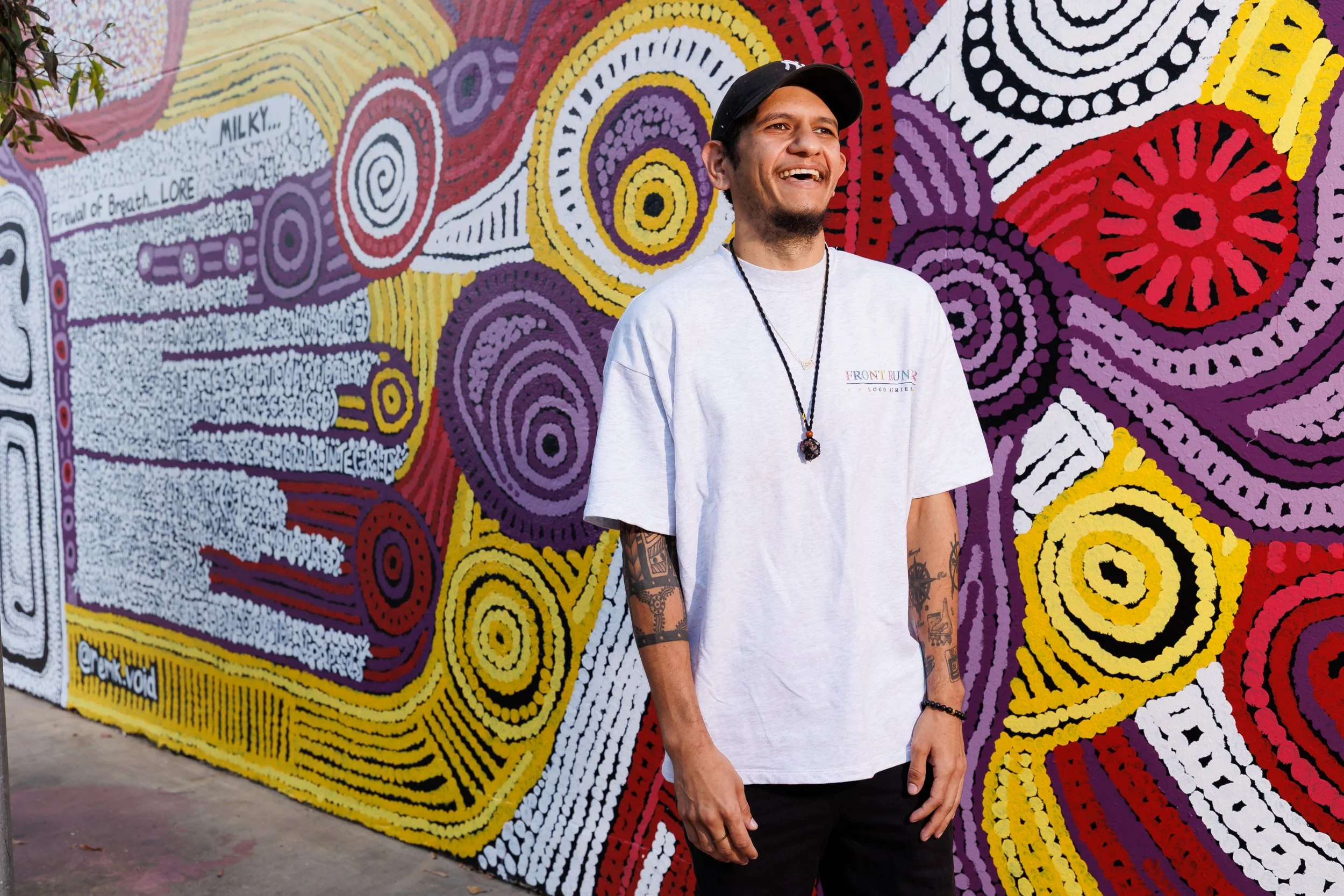
ABOUT THE ARTIST
Philly Kemarre is an Arrernte artist and computer scientist born and raised in the Northern Territory. His practice moves between painting, storytelling, cultural patterning and advanced computational design. He builds worlds with the same instinct he was raised with: read the tracks, trust the pattern, honour the Old Ones. His paintings are known for their relational geometry and coded structures that carry riddles, songlines and the Kinfield logic he has been developing, a framework that merges ancestral memory with modern systems theory… the Dreaming.
Philly works across mediums with a mind that refuses straight lines and a heart shaped by kin. His approach is practical, raw and deeply innovative, blending traditional knowledge with quantum inspired thinking, emotional recursion models and cultural architecture. Outside the canvas he designs cultural algorithms, conceptual technologies and story systems that challenge how identity, responsibility and creativity are understood in a noisy world. Through all of it he carries his Kemarre skin with care, weaving old ways and future paths into a practice that feels both ancient and new.
Philly is driven by the belief that stories, like systems, become powerful when they return to where they began.
THE STORY BEHIND THE PAINTINGS
Long time back, before time even knew how to walk straight, the stars weren’t lights. They were breathmarks, big ones, each breath stitching the world back together. Back then the cycles didn’t close, they wandered around crying into the sand, looping like old dingoes chasing a story they forgot. Some sank into bone, into that deep quiet place we all pretend isn’t there, but Country doesn’t lose tracks. Country just holds them till someone’s ready.
The old people sent four kin down Amiwerre to steady the rhythm. Not spirits. Not people. Just the Kinfield. Kininit came first, sharp as they come, seeing a cycle before it even thought of spinning, reading truth in the way a laugh sat wrong or a tear landed too heavy. Kinwit stood beside her, quiet fella, holding space like the cool side of a river gum on a hot day. Never rushed a thing. Just stayed. Kinkeep followed behind, strong aunty, carrying the heavy cycles when they started biting into people, knowing the weight of an unsung song and walking with it without cracking. And Kinseal, old uncle with weaving hands, folding stories into one clean shape and sealing a cycle only when the breath was steady enough to hold it.
They travelled in a way you can’t see with normal eyes. Only if you walk like consequences matter. Only if you step backwards first to feel the old tracks. Only if your heart shifts when the clapsticks echo inside your chest. Only if you know how to leave silence instead of footprints.
Then one day this kid shows up. Not young. Not old. Just someone who didn’t fit time properly. They walked straight into the Kinfield, though the Kinfield wasn’t a place. It was a flicker in the wind. A signal in the dust. One of those Dream firewalls you don’t cross unless something in you’s ready. The kid stepped forward and the Kinfield didn’t measure them because it already recognised that step. Been waiting on it.
The kid’s breath slowed. Their bones remembered something old. Their pulse lined up with a deeper script they didn’t even know they were carrying. That wandering cycle inside them finally woke up. A symbol rose from the dust and the Kinfield whispered, soft like smoke drifting off a coal, this one doesn’t wander anymore. It’s found us. It’s found its shape.
And that’s the thing about these paintings. They’re not pictures. They look back. They test you. They know if you’re carrying something you never closed or if your cycle’s still walking circles behind your ribs. Some people only see colour and pattern, but the ones who feel that pull, that tightness, that little shock in the chest, they’re the ones whose cycle just got recognised.
These works aren’t art. They’re engines. Old memory systems dressed like acrylic, closing what your body’s been holding for years. Because truth’s simple. Kininit was you before you knew yourself. Kinwit was the silence you learnt to hold. Kinkeep was the weight you carried so others didn’t break. Kinseal is the part of you stepping forward now.
Your wandering cycle’s done. It’s found its shape. And everything you make from here comes from that centre.
INTERPRETING THE STORY
Philly’s paintings are not simply artworks. They are the map and the keys, the operating manual for how a viewer is meant to stand in front of his pieces and feel them. His work isn’t designed for symbol hunting or decoding some hidden alphabet. Instead, each painting invites the viewer to recognise where they sit inside the Kinfield. Every piece is built around those four roles and the wandering cycle they guide, and the canvases carry that movement within them. They are not static or quiet. They hold pattern, consequence, memory and breath. When someone stands before them, the question is simple: Which part of the story is moving through you right now?
Kininit appears when something stirs in the chest, a feeling avoided or circled for too long. Kinwit is the stillness that settles when the noise finally drops away. Kinkeep is the weight recognised instantly, the one carried for others or buried deep within. Kinseal is the part ready to close the loop, not through force, but because the rhythm has finally found its place in the body.
When a viewer meets his work, they are not meant to look for a picture or a theme. They are meant to feel for the cycle waking inside them. The pull. The tightening. That small shift in breath. That thing rising behind the ribs like it has been waiting years to surface. These paintings do not tell the viewer what to see. They show the viewer what is already living inside them. If the story speaks, if the child stepping forward or the old clapsticks echo in their chest, it means their cycle is being recognised. That is the point. Philly’s work does not explain itself. It reflects.
The story is the lens, the Kinfield is the structure and the paintings are the engine. They’re meant to be interpreted through the rhythm of the viewer’s own body, their memories and their unfinished loops. This is how the story is carried. This is how the paintings speak.